
I Hate Children
Our growing intolerance for children and what it says about us.

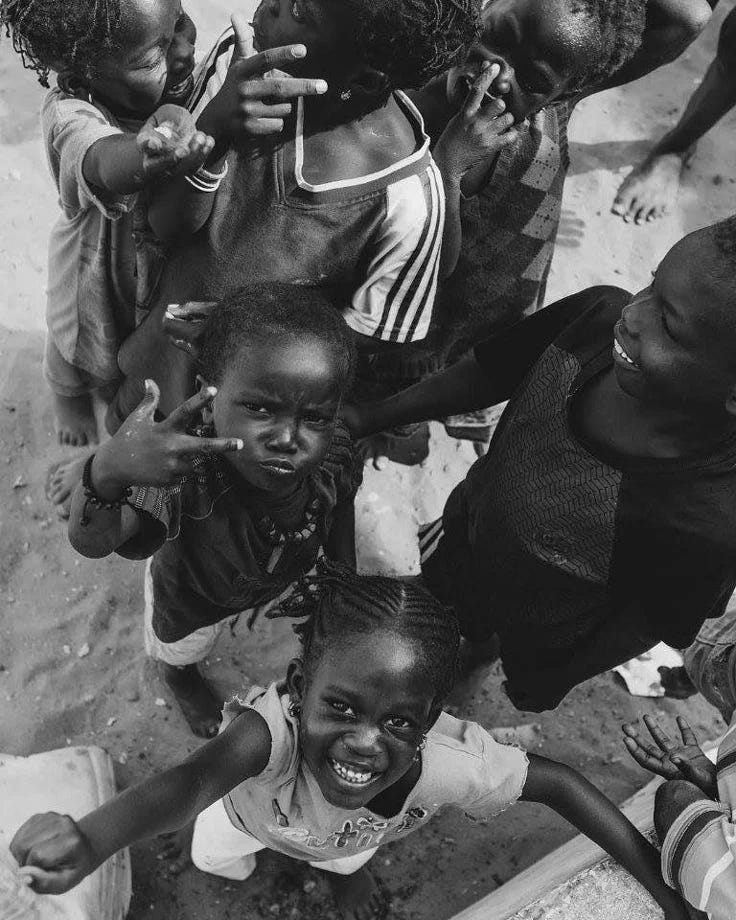
You know the feeling, you board an almost full matatu and the only available sit is next to a parent with a toddler on their lap. Your jaw tightens; you mentally brace yourself. You might be at your nearest JAVA, trying to work, and a child at the next table is loud, restless, wonderfully and mercilessly alive and you feel a spike of irritation so sharp it surprises you. We have all been there and increasingly, we do not hide it.
Declaring that you “hate kids” has become something of a social badge. It signals that you are independent, unbothered by societal expectations, free from the domesticating pull of parenthood. As writer Sian Ferguson observed, the culture of hating children has become cool and edgy a way, especially for young women, to signal that they refuse to be defined by maternal expectations. But somewhere along the way, a reasonable personal preference not wanting children of your own has calcified into something harder and more troubling: a collective impatience with children’s very existence in shared spaces.
Where did this come from? And what does it actually say about us?
A Confession
I am a mother of two. I love my children completely, fiercely, without reservation. And yet, for a long time, I wouldn’t bring them to events. My answer, delivered without a shred of self-consciousness, was: “I love my kids, but I don’t like them enough as friends to be hanging out with them everywhere.” I thought this was self-awareness, a healthy separation of identities and perhaps, in part, it was.
Then came the uncomfortable moment. I was watching a documentary when an interviewee, someone whose character I found deeply unappealing said, verbatim, the same thing about her children. I felt a jolt of revulsion. Not because the opinion was wrong, but because of who shared it. When the worst version of a viewpoint you hold says exactly what you have been saying, you are forced to sit with that discomfort rather than dismiss it.
So, I took it to therapy. Not my usual anxieties about sleep or money, this time, I needed to unpack my feelings about my own children and what I found disturbed me. Underneath my polished philosophy of “maintaining identity outside of motherhood” was something less flattering: a deep need for control. I like order and its predictability. Children, by their very nature aren’t orderly or predicable. Rather than accepting their unpredictability, I had been managing it ,by keeping them at a distance.
We Built a World That Has No Room for Children
My control issues, it turns out, are not mine alone. They are a precise mirror of what we have done as a society.
We have engineered a world optimized for adult efficiency. We queue in silence with our Oraimo earbuds in, we walk unburdened, we prize “respectable” noise levels. Children violate all of this. They are loud they are slow; they ask questions at the wrong moments, they cry in matatus. They simply exist outside the performance of adult restraint and we resent them for it. As one analysis of child-dislike culture noted, our society prizes convenience, and children are a complete drain on it.
But here is the darker layer: we have also physically eliminated the spaces where children could simply exist. In cities like Nairobi, public green spaces that once served as neighborhood playgrounds have been swallowed up by commercial development or converted into paid parking to generate county revenue (Sakaja your days are numbered). Research into urban residential areas of Nairobi’s Eastlands confirms that children in low-income, densely populated neighborhoods face a stark deficit of safe, stimulating environments that are essential for their full development (University of Nairobi, 2019). A 2022 study published in Rural Society examining child-friendly spaces in Dandora, Nairobi and Orlando East, Johannesburg found that context-sensitive urban planning for children remains critically underdeveloped across African cities (Tandfonline, 2022).
The result is children who have nowhere to go. They cannot play in school, many school playgrounds have been grabbed and privatized. They cannot play at home; there is no safe street or open ground. So, they end up in adult spaces, where they are immediately unwelcome. We have created the very problem we complain about and then we tell them to “grow up.”
What Happens to the Children Who Know They Are Unwanted
Here is what the research makes unmistakably clear: children know. They are not oblivious to the way adults sigh when they enter a room, tighten when they speak, or wait for them to leave. Children are exquisitely sensitive to social rejection and the psychological consequences are serious.
Children raised in environments where their self-esteem is consistently eroded or where they are made to feel like a nuisance, a burden, or an interruption do not simply “get over it.” Research linking adverse childhood experiences to adult psychological outcomes shows that early messages about one’s worth leave lasting imprints. The child who internalizes “I am unwanted” does not always grow out of it. They grow into it as either a deeply withdrawn adult or an explosively angry one, both trying, in different ways, to resolve the wound of not having been welcomed.
Wacha Watoi Wakue Watoi
Children are not pre-adults; adulthood is not the destination that validates their existence. They are full human beings right now at their loudest, their messiest, their most inconvenient.
The discomfort many of us feel around children is, at root, a discomfort with unpredictability, with need, with vulnerability. These are things we have trained ourselves to suppress in adult life. When children express them freely, without apology, it confronts us with what we have had to give up.
Choosing not to have children is a valid and personal decision. But that is not what this is about. This is about the cultural permission we have given ourselves to treat children; other people’s, and sometimes our own as inconveniences to be managed rather than people to be welcomed. It is about cities that plan for cars but not for play. It is about a social contract that has quietly decided children should be seen as little as possible and heard even less.
That contract needs to be rewritten. We need to reclaim grabbed public spaces and return them to children. We need to design neighborhoods where a child can move independently, play freely, and be loud without an adult’s eye-roll as a consequence. We need to examine the assumption that order is always better than life and that a child making noise in a café is a problem to be solved rather than a human being doing exactly what human beings do.
Most of all, we need to remember that children are not failing to be adults. They are succeeding at being children. And we owe them a world that allows for that.
We’re too quick to confine children and demand maturity too early. We had our freedom to be loud, curious, and imperfect, why deny them the same? Let children be children.
Thank you for the reminder.
"we need to remember that children are not failing to be adults. They are succeeding at being children."
Such a keen observation. I've always had to catch myself when I say that we should yeet babies into dustbins. Maybe it's because we also came up in families where we were only to be seen not heard. Now we're extending it to the children also not being seen. I really think that it extends to the way we don't care for them when they speak about harms they experience. We want them to be adults about it and learn quickly about how to care for themselves.
Thanks for sharing this.